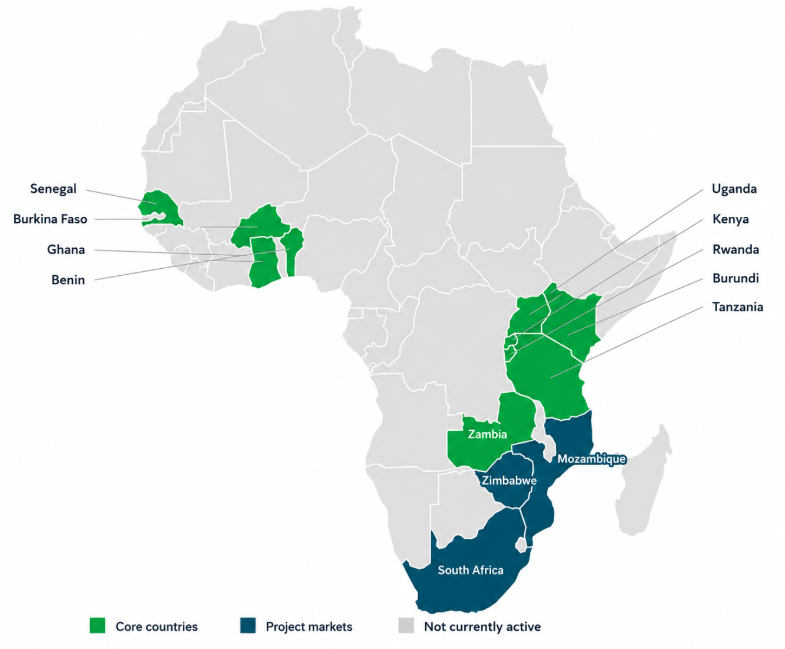
Holland Greentech operates across ten core countries in West and East Africa: Ghana, Benin, Senegal, and Burkina Faso in the west; Kenya, Tanzania, Rwanda, Uganda, Burundi, and Zambia in the east. South Africa, Mozambique, and Zimbabwe are active project markets, and a dedicated international consultancy arm works on projects across the continent.
Our ten core countries carry a full, established product and consultancy offering. South Africa, Mozambique, and Zimbabwe are active project markets, where we're building relationships and validating demand before growing into full operations there too.
Our Footprint
Providing reliable legal solutions tailored to your needs.
Our reach, by the numbers
- 10 core operating countries, plus project markets in South Africa, Mozambique, and Zimbabwe
- ~15,000 customers reached
- 2,700 ha brought under climate-smart horticulture, growing to a targeted 11,000 ha by 2030
- ~15,000 farmers trained in person, on the way to a targeted 30,000 by 2030
- 9,000+ jobs created, on the way to a targeted 38,000 by 2030
- 700,000 people fed for a year through resulting vegetable production
- 85+ partners across research, seeds, technology, and market development
Our home base
Our head office and consultancy team are based in Amsterdam, the Netherlands, the base from which we coordinate our international sourcing, partnerships, and technical expertise.
Our people
Our team works across our African markets and our Netherlands office: agronomists, technical advisors, project managers, and country teams who bring our products, training, and market connections directly to the farmers who need them. 95% of our staff are local hires in the countries where we work, and 50% of our management team are women.
Where we are headed
Our footprint is still growing. By 2030, we're aiming to reach thousands more farmers, create significant new local employment, and substantially increase the volume of vegetables grown sustainably across our markets. That means extending the same integrated model of quality inputs, hands-on training, and market access to more communities across Sub-Saharan Africa, and moving more of our newer markets from “partnership” toward the “full-scale” stage Rwanda has already reached.